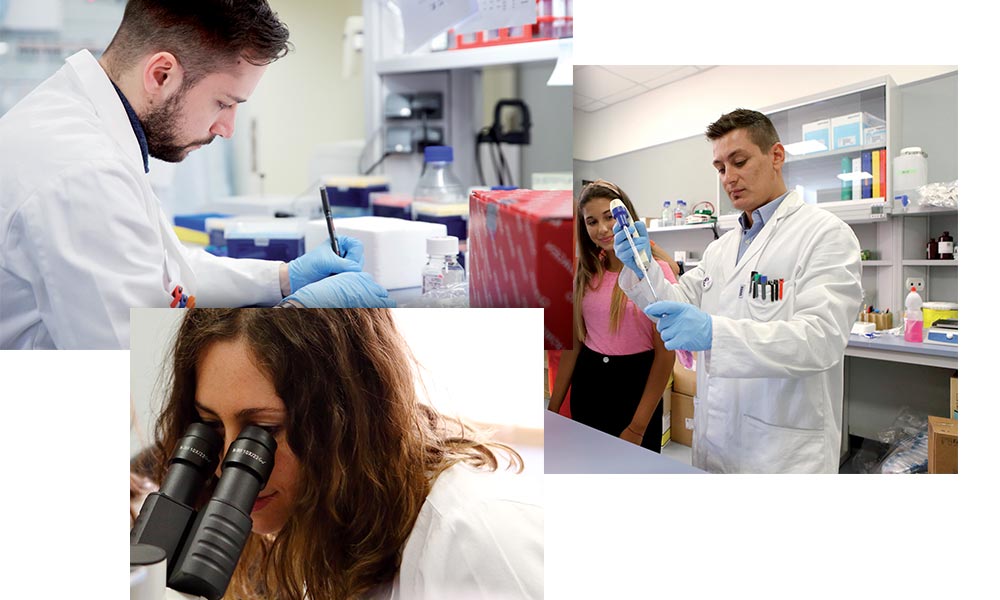
Did you know there is a way to support young researchers with a simple signature?
In your tax return, you can choose to allocate your 5×1000 to Istituto Pasteur Italia, a decision that costs nothing and can make a great difference.
Young researchers are fundamental to the future of research and innovation; let us support them together with new scholarships.
How to donate
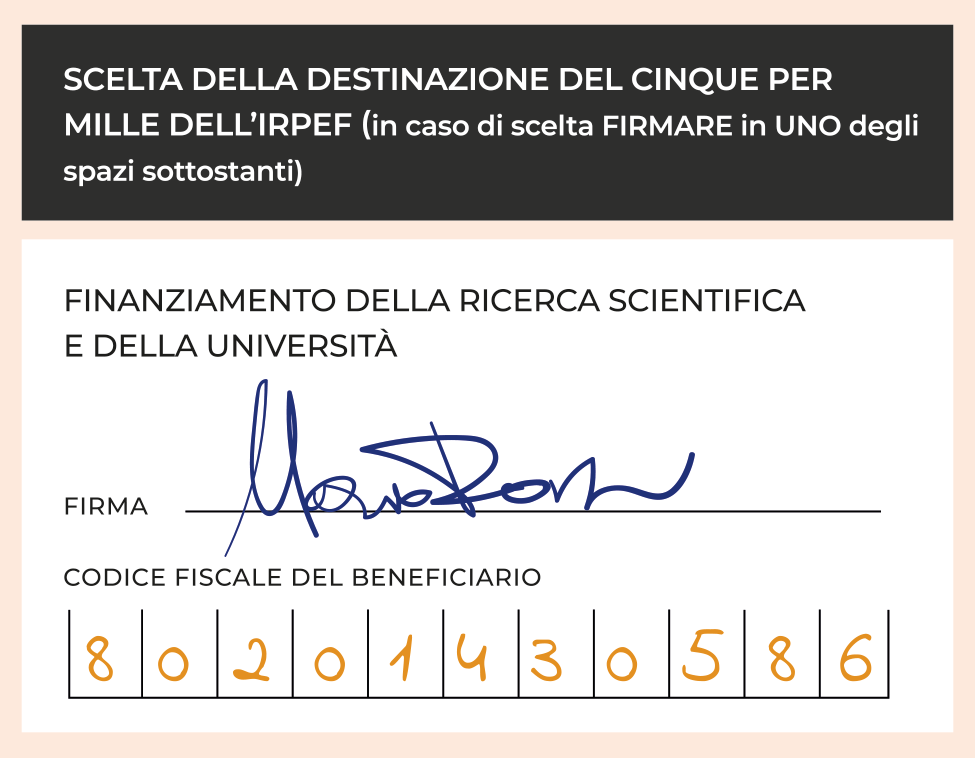
In your tax return or CUD form, write the tax code 80201430586 and sign in the section relating to the funding of Scientific Research and Universities. Also involve your relatives and acquaintances to donate their 5×1000 to Istituto Pasteur Italia.
80201430586
How we use the 5 x 1000
Thank you to those who have chosen to support young researchers with their 5 x 1000!
In 2024 we received 8,603.83 euros. These fundamental resources were allocated to an annual scholarship for research abroad awarded to Dr. Fabio Bordin.
Dr. Fabio Bordin is conducting the research program entitled “Spatiotemporal modulation of the Sonic Hedgehog signaling pathway in 3D sporadic Alzheimer’s Patient-Derived Organoids” at theBerlin Institute forMedical SystemsBiology of the MaxDelbrück Center under the supervision of Prof.NikolausRajewsky.
The Sonic hedgehog (Shh) signaling pathway, known for its key role in neurogenesis and neuronal patterning during development, is also active in the adult brain, where it contributes to neurogenesis, neuroprotection, and injury response. In Alzheimer’s disease (AD), one of the leading causes of dementia, recent studies suggest that the Shh pathway is altered and downregulated, with potential implications in neurodegenerative progression. This project aims to clarify the role of the Shh pathway in AD pathogenesis, using three-dimensional brain organoids derived from iPSC cells of patients and controls.
In the first phase, the activity of the Shh pathway during organoid development and growth will be analyzed, monitoring the expression of receptors (Patched1), co-receptors (Smoothened), and the main transcriptional effectors, with particular attention to Gli1. The transcriptional targets of the pathway (e.g., CyclinD2, Olig2) will also be analyzed in relation to the appearance of classic AD pathological markers, such as Aβ and phosphorylated tau. Furthermore, through immunofluorescence and confocal microscopy, the structure of primary cilia, essential for Shh signal transduction and potentially altered by Aβ deposition, will be studied.
In a second phase, genetically modified organoids will be generated to express Gli1-GFP in a controllable manner through light stimulation (optogenetic PA-Cre), in order to selectively activate the Shh pathway downstream of ciliary damage. The timing and modalities of induction will be optimized and monitored over time through the GFP signal.
Finally, the effect of Gli1 activation will be evaluated at the phenotypic level (Aβ, tau, cell viability and proliferation) and transcriptional level, using OpenST, a spatial transcriptomics technology developed and adapted by the host laboratory for use in organoids. OpenST enables the acquisition of transcriptomic data at subcellular resolution, preserving spatial information within the tissue.
In summary, this project combines advanced models and innovative technologies to investigate the role of the Shh pathway in Alzheimer’s disease, with the aim of identifying new pathogenetic mechanisms and potential therapeutic strategies.