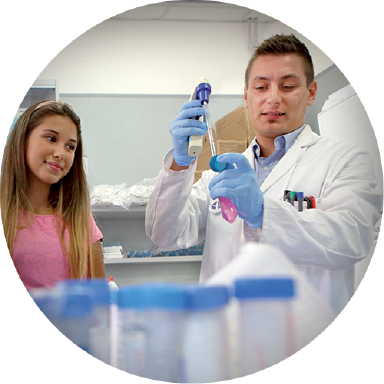
In October 1940, Princess Beatrice Fiorenza Cenci Bolognetti made a choice that looked boldly toward the future, bequeathing her estate to establish a biomedical research institute inspired by the values of the Pasteur Institute in Paris. From that moment, her vision began to take shape. Over the decades, the Istituto Pasteur Cenci Bolognetti joined the Pasteur Network and grew into a vibrant scientific community—funding pioneering research, supporting young scientists as they ventured abroad and returned enriched, and bringing the language of science into schools. Her historic properties in the heart of Rome, carefully preserved and wisely managed, became the engine that fuels this mission. And in 2015, new laboratories opened their doors to researchers developing innovative immunotherapies against infectious diseases and cancer—proof that the Princess’s dream continues to evolve, shaping discoveries that may change lives for generations to come.
1889
1913
1940
1956
1964
1970
1976
1980
2015
Just fuor years after Louis Pasteur had inoculated his vaccine in a boy bitten by a rabid dog, in august Angelo Celli, director of the Institute of Hygiene at the University of Rome, established the first anti-rabies service as a vaccination and scientific research center.
Angelo Celli was followed by Giuseppe Sanarelli, who had been a student of Louis Pasteur in Paris from 1892 to 1894. Despite the natural succession of Institute Directors, some of whom were not strictly Pasteurian, the profound respect for the scientific and human values of the French scientist has always inspired research directions and characterized the training of young university students.
In October, research activities became even more closely linked to the Pasteurian world: Princess Beatrice Fiorenza Cenci Bolognetti signed a will bequeathing the majority of her assets and properties to the University of Rome with the aim of promoting Pasteurian sciences and establishing an autonomous institute specialized in biomedical research, "in harmony with the aims pursued by the Institut Pasteur of Paris and overseas..." At such a dramatic moment when Europe was confronting the horror of war and mass extermination, the last heir of an ancient Roman family wished to lay the foundations for creating a better future and affirming the universality of the scientific and human values that guided the work of Louis Pasteur and continue to guide our activities today.
Less than a year after the Noblewoman's death, the University of Rome initiated procedures to fulfill the Princess's wishes and create a reference point for biomedical research in Italy.
The Foundation named Istituto Pasteur Cenci Bolognetti was established. The Foundation was constituted as a Moral Entity (Presidential Decree 09.12.1975, no. 923 and Presidential Decree 30.06.1976, no. 581), assuming the name "Istituto Pasteur – Fondazione Cenci Bolognetti."
In August, an agreement was signed with the Institut Pasteur of Paris, the first of the Institutes in the world.
The Foundation formalized the beginning of its activities, also as a member of the network of Pasteur Institutes and associated Institutes.
In Palazzo Cenci Bolognetti at Piazza del Gesù, the frescoed ceilings and decorative elements, wooden ceilings and polychrome floors were restored, returning the noble floors of the palace to their former splendor, while adapting the spaces to current technological requirements. The Princess's bequest, consisting primarily of historic real estate in the center of Rome, has been enhanced over the years through careful asset management and attentive maintenance of the properties. Istituto Pasteur Italia – Fondazione Cenci Bolognetti is a member of ADSI, the Italian Historic Houses Association.
The new Laboratories were activated in the recently renovated premises of the former Regina Elena hospital—becoming a research center for studies conducted in the field of molecular medicine, biotechnology and nanotechnology. The Director is Dr. Hiscott—an internationally renowned molecular biologist and virologist. His research program focuses on developing new immunotherapeutic approaches against cancer and infectious diseases: an interdisciplinary theme that will enable various experts from Pasteur and Sapienza to participate in the development of both basic research and translational research programs.