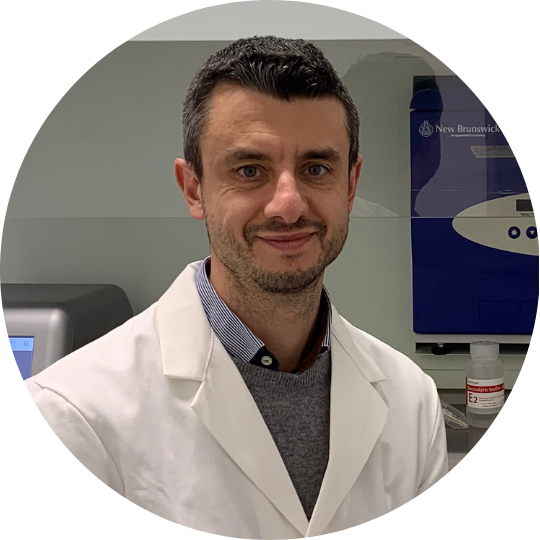
2003-2007 Doctoral Student / Ph.D. program, Genetics and Molecular Biology, Sapienza University of Rome.
2007-2010 Postdoctoral associate. The Rockefeller University, New York, USA. Long term 2008 Human
Frontier Science Program (HFSP) post-doctoral fellowship
2009-2010 Director of the Rockefeller University Stem Cell Derivation Core.
2011-2019 Assistant Professor (tenured in 2014), Sapienza University of Rome.
2019-present Associate Professor, Sapienza University of Rome.
Honors and Awards:
2006. SIBBM (Italian Society of Biophysics and Molecular Biology) Award
2008. RNA Society 2008 poster award in the category “Genetics and Development”
2012. Bioeconomy Award “For the most innovative Italian intuitions of 2011 in the field of biomedical sciences”
2017. 1st Award at the business plan competition StartCup Lazio
2018. National Prize for Innovation Italy. Special award for best project for Equal Opportunities
Scientific interests
My overall research goal is elucidating molecular mechanisms that underlie neurodegenerative and neurodevelopmental diseases of the nervous system, with a particular focus on microRNAs and RNA-binding proteins. To achieve this goal, we take advantage of iPS cell-based in vitro models, including organoids and 3D bioprinted constructs.
Contribution to Science
During my PhD and post-doc, I studied microRNAs in hematopoietic differentiation and embryonic development. In 2005, we identified miR-223’s role in granulopoiesis, demonstrating microRNAs’ regulatory function in cell differentiation. We also revealed complex miRNA-transcription factor interactions in hematopoiesis. I later investigated the miR-430/427/302 family in X. laevis and human embryonic stem cells, showing their role in Nodal signaling and mesendodermal lineage promotion. Using iPSCs, we modeled amyotrophic lateral sclerosis (ALS), generating mutant lines and identifying transcriptomic and microRNA pathway changes. We discovered HuD as a key RNA-binding protein in ALS. Our lab pioneered 3D bioprinting of cortical constructs from human iPSC-derived neural cells and developed the first 3D brain organoids to model fragile X syndrome, advancing tissue engineering and regenerative medicine.
5 Selected publications
Silvestri B, […] Rosa A (2024) HuD impairs neuromuscular junctions and induces apoptosis in human iPSC and Drosophila ALS models. Nat Commun 15: 9618
Garone MG, Salerno D & Rosa A (2023) Digital color-coded molecular barcoding reveals dysregulation of common FUS and FMRP targets in soma and neurites of ALS mutant motoneurons. Cell Death Discov 9: 33
Brighi C, […] Rosa A* & Di Angelantonio S* (2021) Novel fragile X syndrome 2D and 3D brain models based on human isogenic FMRP-KO iPSCs. Cell Death Dis 12: 498. *Co-last authors
Garone MG, […] Rosa A (2021) ALS-related FUS mutations alter axon growth in motoneurons and affect HuD/ELAVL4 and FMRP activity. Commun Biol 4: 1025
De Santis R […] Rosa A (2019) Mutant FUS and ELAVL4 (HuD) Aberrant Crosstalk in Amyotrophic Lateral Sclerosis. Cell Rep 27: 3818-3831.e5
On-going Grants
Project Title
Funding source
Amount (Euros)
Period
Role of the PI
HSPB3: a promising candidate for the maintenance of the neuromuscular system
Muscular Dystrophy Association (MUR)
140.000
1/9/2022 -31/8/2025
Co-PI (5 % of time)
CN3_Spoke_3 - Sviluppo di terapia genica e farmaci con tecnologia a RNA
MUR - PNRR
186.025
1/11/2022 -28/2/2026
Co-PI (25 % of time)
Unraveling the role of SUMO2/3 as a modifier of TDP-43 solubility: a new therapeutic avenue for ALS
AriSLA
35.200
1/3/2023 -28/2/2027
Co-PI (5 % of time)
HSPB3: understanding its role in the pathophysiology of the neuromuscular system and testing its druggability for future therapeutic purposes
MUR - PRIN 2022
87.737
18/10/2023 -28/2/2026
Co-PI (15 % of time)
Generation and characterization of a new in vitro model for GNAO1 encephalopathy based on human iPS cells and cortical organoids
MUR - PRIN 2022 PNRR
120.610
1/12/2023 -28/2/2026
PI (15 % of time)
StressHUD, Investigating the Mechanisms Underlying Oxidative Stress-Induced HuD Expression in Sporadic ALS
AriSLA
60.000
1/5/2025 – 30/4/2026
PI (10 % of time)
Generation and characterization of neuromuscular organoids as model systems for amyotrophic lateral sclerosis
ISTITUTO PASTEUR ITALIA Fondazione Cenci Bolognetti
40.000
1/3/2025 – 28/2/2027
PI (10 % of time)
Complete list of published work in MyBibliography: