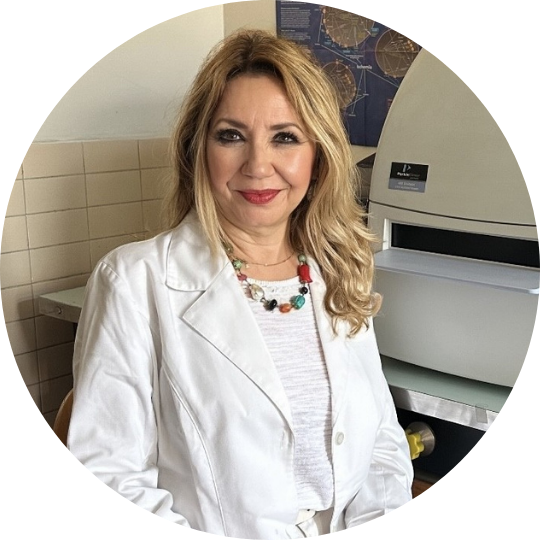
2023 National scientific qualification for a full professorship (session 2021-2023) in the academic recruitment area “Pharmacology, Clinical Pharmacology and Pharmacognosy.
2022 until today – Associate Professor in Pharmacology at the Department of Physiology and Pharmacology “Vittorio Erspamer”, Sapienza University of Rome, Rome, Italy.
2004-2022 Researcher in Pharmacology. Department of Physiology and Pharmacology “Vittorio Erspamer”, Sapienza University of Rome, Rome, Italy.
1998-2004 Postdoctoral fellow. Department of Physiology and Pharmacology “Vittorio Erspamer”, Sapienza University of Rome, Rome, Italy
1997-1998 Exchange scholarship from the Accademia dei Lincei\Royal Society. Laboratory of Neuropharmacology, School of Biological Sciences, University of Surrey, Guildford, U.K
1996 PhD in Cellular and Molecular Pharmacology. Institute of Medical Pharmacology, Sapienza University of Rome, Rome, Italy.
Honors and Awards
Research grant (FABR: Financing of Basic Research Activities Funding) sponsored by Sapienza University of Rome for basic research.
Travel grant sponsored by the Organizational Committee of the International Narcotics Research Conference (INRC) for participation in the “30th International Narcotics Research Conference”. Saratoga Springs, New York, U.S.A., 10-15 July 1999.
Travel grant sponsored by the Board of Directors of the Italian Society of Pharmacology (SIF) for participation in the “XXIX Congress of the Italian Society of Pharmacology”. Florence, 20-23 June 1999.
Travel grant. Funding by the Board of Directors of the Italian Society of Pharmacology (SIF) for participation in the “Joint Meeting of the French and Italian Societies of Pharmacology”. Nantes, France, 15-17 March 1999.
Travel grant sponsored by the Organizational Committee of the International Narcotics Research Conference (INRC) for participation in the “29th International Narcotics Research Conference”. Garmish-Partenkirchen, Germany, 20-25 July 1998.
Travel grant sponsored by the Board of Directors of the Italian Society of Pharmacology (SIF) for participation in the “6th Joint Meeting of the Italian, Hungarian and Polish Pharmacological Societies”. Pisa, 14-16 May 1998.
Research grant sponsored by the Italian Society of Pharmacology (SIF) to join a foreign laboratory (Laboratory of Neuropharmacology, School of Biological Sciences, University of Surrey, Guildford, U.K) 1997.
1997. Travel grant sponsored by the Board of Directors of the Italian Society of Pharmacology (SIF) for participation in the “XXVIII National Congress of the Italian Society of Pharmacology”. Bari, 30 April-3 May 1997.
Travel grant sponsored Funding by the Organizational Committee of the International Narcotics Research Conference (INRC) for participation in the “28th International Narcotics Research Conference”. Long Beach, California, July 21-26, 1996.
Scientific interests
My research has always focused on investigating the functional role of neuropeptides. I have studied their involvement in various biological activities, particularly in the modulation of nociceptive transmission. For several years, I was involved in studies on dermorphins and deltorphins, two major classes of opioid peptides, using receptor binding techniques and in vitro and in vivo pharmacological activity assays. I was then involved in the identification of a new system of proteins (Bv8/prokineticins) and their receptors and contributed to the study of the various physiological and pathological activities in which this system is involved. In particular, I have been dedicated to the elucidation of the molecular and cellular mechanisms underlying prokineticin-induced nociceptive sensitization and to the study of the involvement of the prokineticin system in inflammation/neuroinflammation.
Contribution to Science
During my research, I have contributed to demonstrate the involvement of the new chemokine prokineticin 2 (PK2) and its receptors (PKR1 and PKR2) in inflammation/neuroinflammation. In particular, I have shown that PK2 contributes to inflammatory and neuropathic pain and to neurodegenerative diseases such as Alzheimer’s disease (AD) and Parkinson’s disease (PD). The most interesting aspect that I have showed is the fact that blocking PKRs with selective antagonists significantly reduces pain and AD-induced cognitive impairment, showing that the PK system could represent a potential new pharmacological approach for inflammatory-based pathologies.
5 Selected publications
Schirinzi T., Maftei D., Maurizi R., Albanese M., lara Simonetta C., Bovenzi ·R., Bissacc o J.· Mascioli D., Boffa L., Di Certo·M.G., Gabanella F., Francavilla B.,·Di Girolamo S., Mercuri N.B., Passali F.M., Lattanzi R., Severini C. “Post‐COVID‐19 Hyposmia Does Not Exhibit Main Neurodegeneration Markers in the Olfactory Pathway”. Molecular Neurobiology, 2024, 61:8921–8927. (*: co-last authorship).
Schirinzi T., Lattanzi R*., Maftei D., Grillo P, Zenuni Hi, Boffa L., Albanese M., Simonetta C., Bovenzi R.,Maurizi R, Loccisano L., Vincenzi M., Greco A., Di Girolamo S., Mercuri N.B., Passali F.M., Severini C. “Substance P and Prokineticin-2 are overexpressed in olfactory neurons and play differential roles in persons with persistent post-COVID-19 olfactory dysfunction”. Brain, Behavior, and Immunity, 2023, 108 302–308. (*: co-first authorship).
Impellizzeri D; Maftei D; Severini C; Miele R; Balboni G; Siracusa R; Cordaro M; Di Paola R; Cuzzocrea S; Lattanzi R. “Blocking prokineticin receptors attenuates synovitis and joint destruction in collagen-induced arthritis”. Journal of Molecular Medicine, 2023, 101(5):569-580.
Maftei D., Ratano P, Fusco I., Marconi V., Squillace S., Negri L., Severini C., Balboni G., Steardo L., Bronzuoli M.R, Scuderi C., Campolongo P., Lattanzi L. “The prokineticin receptor antagonist PC1 rescues memory impairment induced by β Amyloid administration through the modulation of prokineticin system”. Neuropharmacol., 2019, 158:107739.
Lattanzi R., Maftei D., Petrella C., Pieri M., Sancesario G., Schirinzi T., Bernardini S., Barbato C., Ralli M, Greco A, Possenti R., Sancesario G., Severini C. “Involvement of the Chemokine Prokineticin-2 (PROK2) in Alzheimer’s Disease: From Animal Models to the Human Pathology”. Cells, 2019, 13;8 (11):1430.
On-going Grants
Project Title
Funding source
Amount (Euros)
Period
Role of the PI
Effect of prokineticin receptor antagonists on angiogenesis in eye diseases
Collaboratio Lattanzi-Lambiase-Dompè
40.000
2023-2026
PI (7 % of time)
The prokineticin system as a link between Alzheimer’s disease and dysbiosis
Pasteur Fondation Grant
40.000
2025-2027
PI (10 % of time)
Complete list of published work in MyBibliography: